Short answer
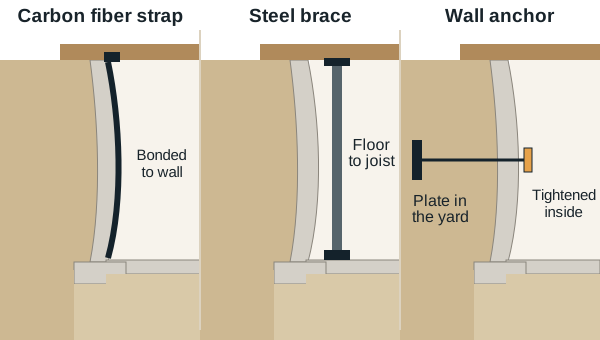
Basement walls bow when soil pressure outside pushes them inward. In Anderson, the usual combination is a 1950s-1960s hollow block wall against dense till that stays saturated in spring. Repairs include carbon fiber straps (about $350-$1,000 each), steel braces, and wall anchors (about $400-$700 each). Reducing water against the wall is part of every lasting fix.
A bowing wall sounds alarming, and sometimes it is. More often it’s a slow problem that can be stopped if it’s caught early and the water pushing on the wall is dealt with too.
Why walls bow in Anderson
Two local facts line up:
- The walls. About 31% of Anderson homes were built in the 1950s and 1960s (U.S. Census ACS 2024), when hollow concrete block foundations were common. Block walls are strong in compression but weaker against sideways pressure, especially along the mortar joints.
- The soil. Most of the city sits on dense glacial till, and the soil survey estimates a seasonal water table within about 3 feet of the surface under 69% of sampled city land (USDA NRCS). Saturated soil weighs more and pushes harder, and in winter, freezing soil near the top of the wall adds more.
The pressure peaks in late winter and spring, the same season as snowmelt leaks, which is why many owners first notice a new crack or a worse bulge then.
Which local homes are most exposed
The combination to watch is older block walls on wet ground. In the town samples (Census ACS; USDA NRCS):
| Town | Homes built before 1960 | Sampled land very limited for basements |
|---|---|---|
| Elwood | 61.9% | 92% |
| Edgewood | 67.4% | 98% |
| Middletown | 59.3% | 24% |
Elwood and Edgewood pair older housing with wet ground. Middletown has just as many older homes, but its sampled land is mostly well drained, so soil pressure on walls tends to be lower there. These are area-wide figures; your own wall and lot are what count.
Signs a wall is moving
- A long horizontal crack, often halfway up a block wall.
- Stair-step cracks running toward the corners. Our crack repair page explains how to read them.
- The wall leaning in at the top, or bulging in the middle.
- Blocks shifted out of line, or a gap opening at the sill plate.
Measure it. Snap a string line or hold a long level against the wall at the same spots each month and write down the gap. A wall that doesn’t change through a full year is very different from one that moves every spring.
The repair options
| Repair | How it works | Best for | Typical cost |
|---|---|---|---|
| Carbon fiber straps | Bonded to the inside face, anchored at top and bottom | Walls with limited movement | About $350-$1,000 per strap |
| Steel braces (I-beams) | Bolted from the floor to the floor framing | Walls with more movement; no yard needed | Priced per beam |
| Wall anchors | Rods through the wall to plates buried in the yard, tightened over time | Walls with room outside; can gradually straighten | About $400-$700 per anchor |
| Rebuild | Excavate and rebuild the damaged section | Severe bowing or displaced blocks | Highest |
Published ranges from U.S. cost guides (sources). A typical 30-foot wall with anchors about every 5 feet runs roughly $2,400-$4,200 in anchors alone.
Wall anchors need clear yard space outside the wall, which driveways, porches and close neighbors can rule out. Straps and braces work from inside.
Fix the water too
Reinforcement holds the wall. Reducing the water against it is what keeps the pressure down:
- Roof water first: downspouts extended well away and grading that slopes away. See yard drainage.
- Drainage at the footing: interior drain tile relieves water pressure on the wall and keeps the floor dry. On Anderson’s wet ground, wall repair and drain tile often go together.
- Cracks: once the wall is stable, seal or repoint the cracks. See crack repair.
What a good assessment includes
- Measurements of how far the wall is out of plumb, and where.
- A look at the outside: grading, downspouts, trees and anything heavy near the wall. See yard drainage.
- The cause in plain words, such as water pressure, frost or a heavy load near the wall.
- A plan for the wall and the water together, with the drainage piece priced separately. Typical prices for both are on the cost page.
Questions to ask
- How far has the wall moved, and how will you measure it after the repair?
- Will this repair stop movement, straighten the wall, or both?
- What happens to the drainage along this wall?
- Does the warranty transfer if I sell the house?
- Do you recommend an engineer, and will you work from an engineer’s design?
Exterior excavation lets a crew straighten or rebuild a wall and waterproof it at the same time. See exterior waterproofing. If seepage at the floor-wall joint comes with the bow, the same saturated soil is behind both.
When to call an engineer
Ask for a structural engineer’s assessment if the wall has moved more than a small amount, is leaning at the top, has blocks out of line, or keeps moving after a repair. An engineer’s report also helps when you’re buying or selling a house with a repaired wall.