Short answer
A sump pump removes groundwater that collects in a pit below the basement floor. In Anderson, where the soil survey estimates a seasonal water table near the surface under much of the city, pumps can run for weeks each spring, so sizing, a reliable switch, a battery backup and a discharge that sends water well away from the house matter more here than in drier towns.
Ask Anderson homeowners about their basements and the sump pump comes up fast. On ground that holds water for months, the pump is what keeps the floor dry, and it usually works harder here than in towns on sandy soil.
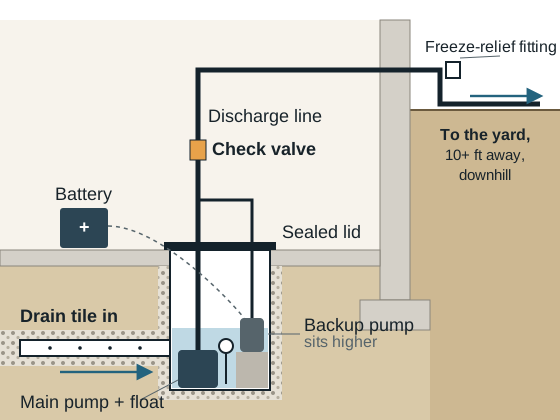
Why pumps work hard in Anderson
The soil survey estimates a seasonal water table within about a foot of the surface at 56% of sampled city land (USDA NRCS). In late winter and spring, the pit refills as fast as the pump empties it, sometimes for weeks. That has three consequences:
- Sizing matters. The pump has to keep up with spring inflow, not an average day.
- Wear matters. A pump that cycles thousands of times a season wears out sooner.
- Backup matters. The storms that bring the most water also knock out power, and a pit on wet ground can overflow within hours.
The parts of a good system
- A sealed basin sized for the inflow, set at the low point and fed by drain tile.
- A submersible pump with a reliable vertical or electronic float switch. Cast-iron housings shed heat better under heavy use.
- A check valve so water in the discharge pipe doesn’t fall back into the pit.
- A discharge line that exits above grade, carries water well away from the house and drains between cycles. See discharge and freezing.
- A battery or water-powered backup and an alarm. See battery backups.
Sizing for Anderson’s spring
There’s no single right horsepower. What matters is how much water comes in at peak and how high the pump has to lift it. A contractor should look at how fast the pit refills in a wet spell, measure the lift to the discharge, and choose a pump whose rated flow at that height covers peak inflow with room to spare. If you have an existing pit, timing how long it takes to refill during the wettest week gives a useful number to share.
Signs your system needs attention
- The pit fills nearly to the rim before the pump kicks on.
- The pump strains, rattles or feels hot after a wet week.
- Water shows up at the floor-wall joint while the pit stays low. Water isn’t reaching the pit, so the drainage feeding it needs a look.
- Sand or silt builds up in the pit, a sign the drain tile is carrying soil with the water.
- There’s no pit at all, and water comes up through the floor every spring.
Choosing the pump and switch
| Choice | Options | What holds up on wet ground |
|---|---|---|
| Switch | Tethered float, vertical float, electronic sensor | Vertical and electronic switches fit narrow pits and can’t swing into the pit wall |
| Housing | Plastic, cast iron, stainless steel | Cast iron or stainless sheds heat better through long run times |
| Style | Submersible or pedestal | Submersible pumps are quieter and cooled by the water around them; a pedestal motor sits above the pit, easier to reach but louder |
| Capacity | Rated flow at a given lift | Read the maker’s flow chart at your actual lift instead of going by horsepower |
Common jobs and costs
| Job | Typical cost |
|---|---|
| Replace a pump in an existing pit | $400-$1,200 |
| New pit and pump | $800-$2,500 |
| Add a battery backup | $600-$1,600 |
| Common repairs (switch, check valve, clog) | about $75-$550 |
Published ranges from U.S. cost guides; see the cost page for sources.
The detailed guides:
- Pump replacement: when to replace, what a good replacement includes
- Pump repair: what’s fixable and when replacing makes more sense
- Battery backup: run time for long outages, alarms
- Discharge and freezing: where the water should go, and winter freeze-ups
Where the water goes
Send it to your yard, at least 10 feet from the house, onto ground that slopes away. Many older Anderson homes have a sump or downspouts tied into a floor drain or the sewer. Anderson has combined sewers, and clean water in the sewer adds to storm overloads. Ask the city before changing a discharge, and see combined sewers and backups.
Do you need a sump at all?
Not every wet basement does. If water shows up only after storms, in one corner under a downspout, fix the roof water and the grading first: see yard drainage. If water comes up the floor drain and smells, it’s the sewer, and a pump won’t help: see sewer backup or groundwater?
A sump earns its place when groundwater reaches the slab. Ground conditions vary around the county. In our soil samples, Middletown and Chesterfield were mostly well drained (76% and 62% of points), while the Lapel and Fortville samples were almost all poorly drained (USDA NRCS). The nearby towns page compares them.
Questions to ask a contractor
- How did you size the pump? What inflow and lift did you assume?
- Which switch will you use, and how will it stay clear of cords and the backup’s float?
- Is the basin sealed, and how big is it?
- Where does the discharge end, and what keeps it from freezing?
- Which backup do you recommend, and how long will it run at my pit’s refill rate?
- Does the warranty cover the pump, the labor, or both?
Maintenance that prevents most failures
- Pour a bucket of water into the pit each spring and fall and watch the pump start, empty the pit and stop.
- Keep the float free of cords and the pit free of debris.
- Check that the discharge outlet is open, especially after snow.
- Replace the pump before it’s 10 years old if it works hard every spring.