Short answer
Most basement cracks in Anderson are narrow shrinkage cracks in poured walls or stair-step cracks in block walls. Leaking poured-wall cracks are usually sealed by injection, typically $300-$1,500 per crack. Horizontal cracks in block walls, or cracks that keep widening, point to soil pressure from saturated till and need structural attention, often along with drainage.
Cracks are the most visible thing in many basements, and they cause a lot of worry. Most are easy to classify once you know what to look at: the wall type, the direction, the width and whether it’s changing.
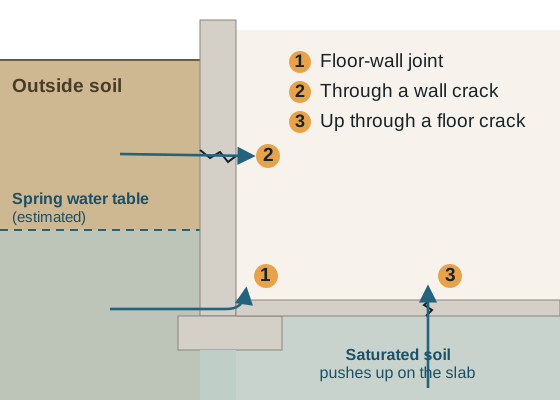
Reading a crack
| Crack | Common in Anderson | What it usually means | Usual fix |
|---|---|---|---|
| Thin vertical crack, poured wall | Newer homes | Concrete shrinkage; may leak | Injection if it leaks |
| Stair-step crack along mortar joints, block wall | Post-war homes (1950s-1960s) | Settlement or soil pressure | Monitor; repoint or reinforce if moving |
| Horizontal crack in a block wall | Post-war homes on wet till | Soil pressure pushing the wall in | Structural repair plus drainage; see bowing walls |
| Crack in the floor slab with water rising | Wet soils with a high water table | Water pressure under the slab | Drainage; seal after |
| Gap where the wall meets the floor | Very common | Not a crack; the cold joint | Drainage; see floor-wall joint |
About 31% of Anderson homes were built in the 1950s and 1960s (U.S. Census ACS 2024), when hollow concrete block walls were common. Those walls crack differently from poured concrete and can’t be sealed by injection.
Sealing leaking cracks in poured walls
- Polyurethane injection expands and stays flexible. It’s the common choice for leaking, non-structural cracks.
- Epoxy injection bonds the concrete back together. It’s used where the crack has some structural meaning.
Injection fills the crack through the full wall thickness from the inside. It works on poured concrete. It doesn’t work on block, where water travels through the hollow cores.
Block wall cracks
Stair-step cracks in block walls follow the mortar joints. A stable, narrow stair-step crack can be repointed. Wide or growing cracks, blocks out of line, or a horizontal crack along the middle courses mean soil is pushing on the wall. On Anderson’s saturated till, that pressure is highest in late winter and spring. Treat the wall and the water together: reinforcement for the wall and drainage to relieve the pressure. See bowing walls and interior drain tile.
Floor cracks
A floor crack that leaks is a symptom of water under the slab. On the many Anderson lots where the soil survey estimates a shallow seasonal water table, sealing the crack just moves the water to the next weak point. Drain tile and a sump relieve the pressure; sealing the crack afterward cuts down on moisture and soil gas. See water through the floor.
Signs a crack needs a professional
- It’s horizontal, especially halfway up a block wall.
- It’s wider than about 1/4 inch, or wider at one end than the other.
- One side has shifted in or out compared with the other.
- It reopens after being sealed, or grows from one season to the next.
- Doors or windows above it have started to stick.
Alternatives and when they’re enough
- Leave it and watch. A dry hairline crack in a poured wall needs only a pencil mark and a date.
- A homeowner injection kit can seal one narrow, clean, leaking crack in a poured wall when water isn’t pushing hard.
- Drainage instead of sealing. If the crack leaks only in spring, along with seepage at the floor edge, the water table is the problem. Interior drain tile and a sump pump relieve the pressure behind every crack at once.
- Outside repair. When the inside face can’t be reached, or the crack is part of a wall that needs excavating anyway, exterior waterproofing seals it from the soil side.
Cracks that leak mostly in late winter and early spring follow the same rhythm as spring and snowmelt leaks.
Costs
Crack injection typically runs $300-$1,500 per crack, with polyurethane leak-sealing at the lower end and structural epoxy higher. Additional cracks on the same visit usually cost less. Wall reinforcement costs more (published ranges; sources).
Watch it before you fix it
Mark the ends of a crack with a pencil and the date, and measure its width each month. A crack that’s stable through a full year of seasons is a very different problem from one that grows every spring.
Questions to ask a contractor
- Is this crack structural, and what tells you so?
- Polyurethane or epoxy, and why that one?
- Does the repair carry a warranty if the crack leaks again? How does your price compare with the published ranges?
- Is there water pressure behind it that drainage should address first?
- Will you write down the crack’s location, length and width for my records?
Keep a record
Write down where each crack is, how wide it was, when it was sealed and by whom. Buyers and inspectors ask about basement cracks. A dated record of a stable, repaired crack answers the question better than fresh sealant with no history. Houses in older areas such as Elwood, where 40% of homes date from before 1940 (Census ACS), often carry decades of patches. Knowing which are old and stable saves money.